
Princess Siege started with card costs. I removed them because I wanted the battles to feel more like Gwent. Then I played the no-cost version and decided the costs needed to come back.
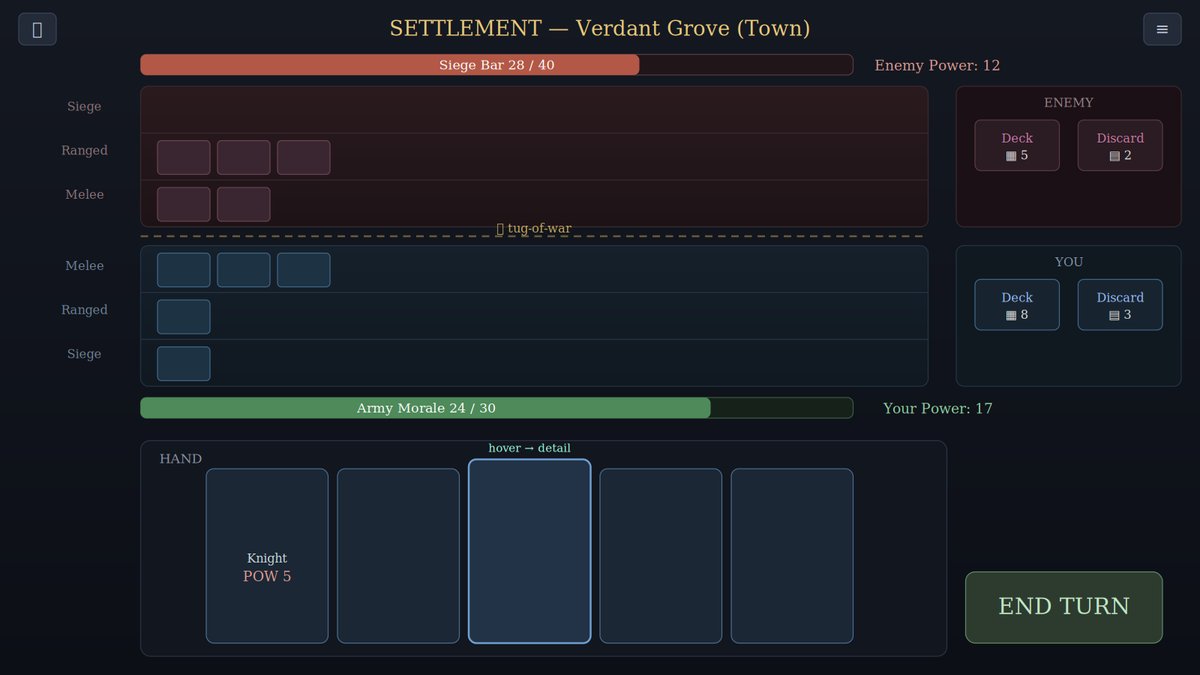
The game now uses Command. You receive three Command at the start of each turn, spend it to play cards and lose anything left when the turn ends.
I might change it again.
Starting with the usual answer
The first prototype used a resource called Supply. I chose that because paying to play cards is normal in card games. Slay the Spire, Monster Train, Hearthstone and plenty of others give you a limited amount of energy or mana and ask you to decide how to spend it.
The prototype gave you three Supply every turn. A Levy cost one, an Archer cost two and a Knight cost three.
There was not much more thought behind it at first. Card games normally have costs, so the first version of mine did too.
Removing Supply
As the combat became more inspired by Gwent, I started questioning whether those costs belonged there.
Gwent does not charge mana to play a card. You play one card, your opponent plays one card and control passes back and forth. The important choice is which card you commit and when.
I removed Supply from Princess Siege and made the hand the only limit. You would draw back up to five cards at the start of your turn, play whatever you wanted and then let the enemy settlement take its turn.
It made the cards and interface simpler. It also removed most of the decision from playing a hand.
Units stay on the board after being played. If every card in your hand makes your board stronger and none has a cost, you generally play all of them. There is little reason to hold a Levy if you can play the Levy, the Archer and the Knight.
It started to feel like solitaire. I was putting my cards down and then pressing End Turn.
The difference from Gwent was not the Power system. It was the turn structure. Gwent works without mana because playing a card ends your action. Princess Siege gave you a complete turn with no limit on how many cards you could play.
Bringing costs back as Command
The game now uses Command. You get three each turn and it does not carry over. A Levy costs one, an Archer two and a Knight three.
With three Command I can play:
- Three Levies and start building a wide Formation.
- An Archer and a Levy, spreading units across two rows and adding a ranged attack.
- One Knight, spending the whole turn on a stronger unit.
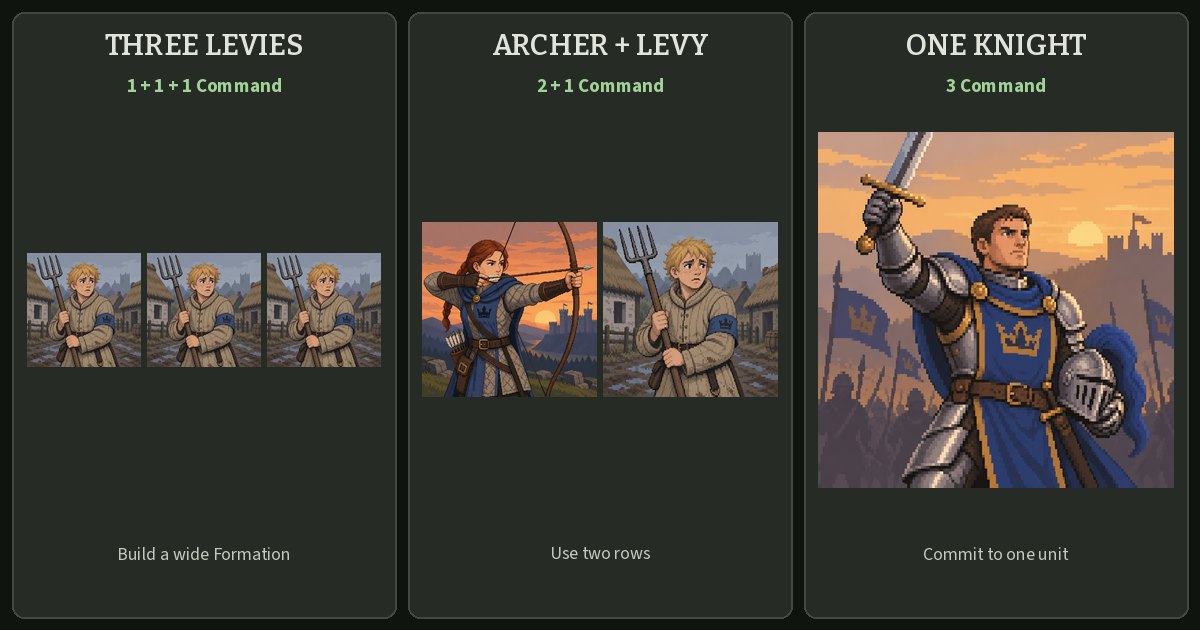
I cannot do all three. The cards have to compete for the same turn.
Command also gives me another way to balance cards. A Knight does not only need to be stronger than a Levy. It needs to be worth three Levies, or worth giving up the flexibility of an Archer and a Levy.
There is still another version I want to consider: alternating one card at a time, as Gwent does. That might preserve meaningful choices without a resource. Command fits the turn structure I have now, but I do not consider the problem permanently solved.
A mechanic is not a sentence
Card costs were not the only apparently simple rule that became more complicated when I implemented it.
The first description of Formation said that a unit should receive a bonus while adjacent to another Formation unit. Princess Siege does not have individual positions within a row. The cards are sorted automatically, so adjacency does not represent a decision the player made.
Formation now triggers when a unit enters a row that already contains another Formation unit. The new unit permanently gains +1 Power. The first soldier establishes the row and later soldiers benefit from joining it.
Guard had a similarly vague beginning: it protected nearby or backline units. Now it has a specific job. If a unit in a row is going to be hit, Guards in that row are targeted before units without Guard. Targeting remains automatic, so Guard changes who can be selected rather than asking the player to open another targeting interface.
There could eventually be a stronger version that protects more than one row, but ordinary Guard only protects its own.
One extra life and two kinds of defence
The elven Regrow mechanic began as a general idea about healing and revival. Regrow now gives a unit one extra life. When it dies, it returns once and then loses Regrow. Letting it return indefinitely would obviously be too strong.
I have also separated Shield from Armour.
Shield is an extra health pool. Damage removes Shield before reducing the unit’s Power, and Shield does not add to the Power comparison. Once it is gone, it is gone.
Armour is permanent damage reduction. That is a stronger identity, so I am saving it mainly for the dwarves. Humans can protect their soldiers with shields; dwarves are supposed to be difficult to damage in the first place.
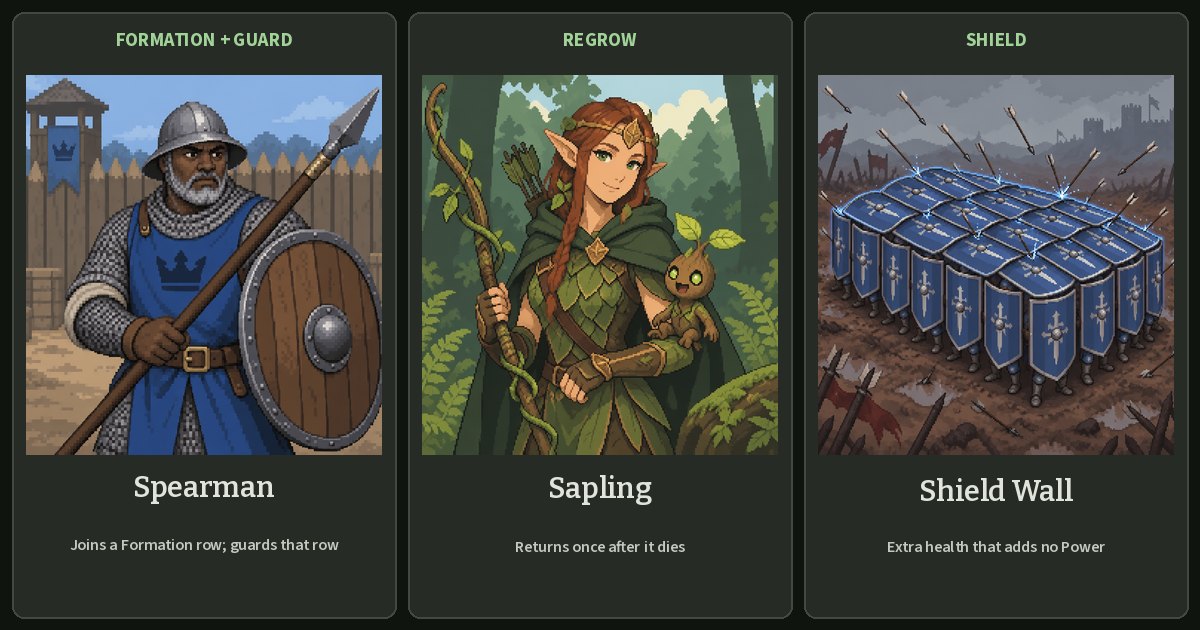
Those differences sound small in a document. In a game, they decide which cards survive, which combinations are useful and whether two factions actually play differently.
The questions underneath a turn
Building the prototype has made me realise how much depends on rules that players may never consciously notice.
Do you draw five new cards, or draw until you have five? Do unused cards stay in your hand? When a unit dies, where does its card go? Can that card be drawn and played again while another copy is still on the board? Does playing one card end your action, or can you keep playing until a resource runs out?
None of those is the headline idea for Princess Siege. Together, they determine what a turn feels like.
That is why I want to settle the first couple of regions before building the other five. Adding cards and art is not useful if playing a turn is not interesting.
I did not get the costs right on the first attempt, and the current answer may not be the final one. The only useful way I have found to resolve it is to build each version, play it and pay attention to which decisions are real.
If you have worked through a similar resource problem in your own game, I would be interested to hear where you landed: hello@teamhayat.com.